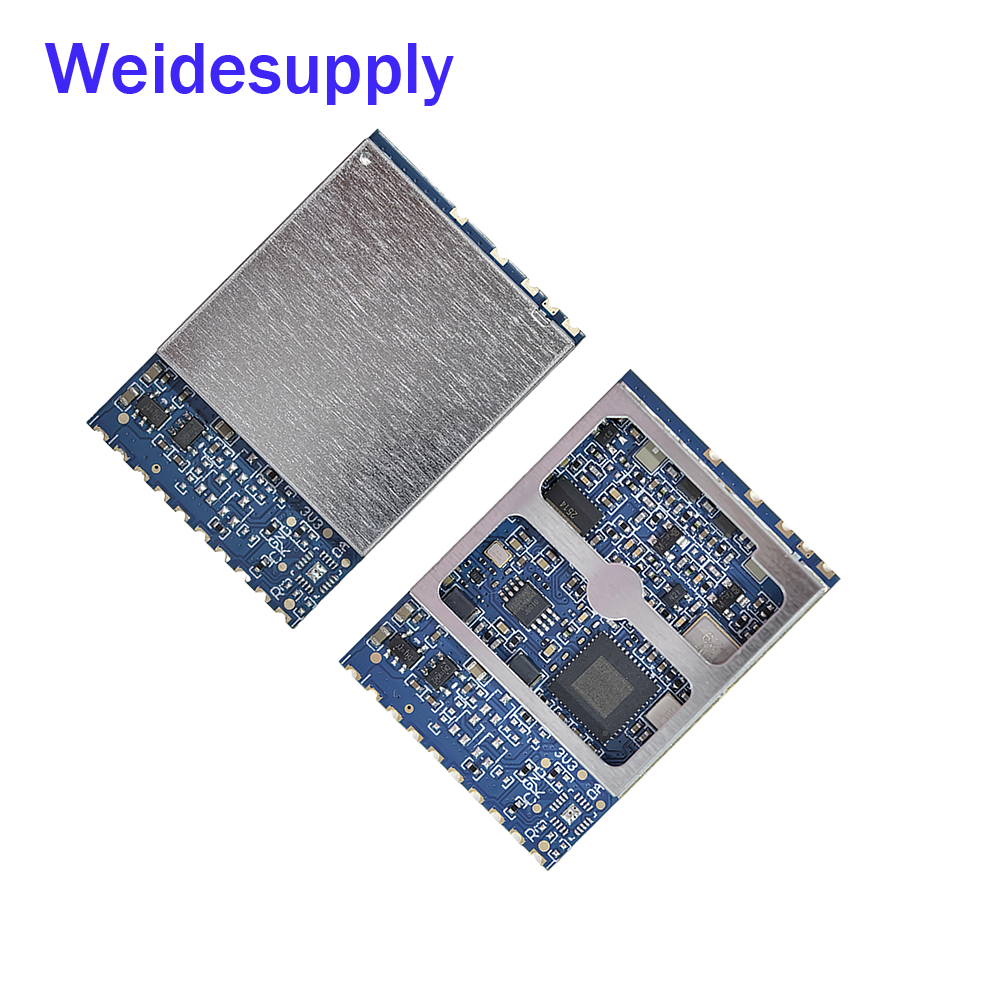
SK3500-SPI FPV Receiver Module
SK3500-SPI 3.3G VRX Wireless FPV Image Transmission Open Source SPI Mode High Sensitivity Receiver
(3.1G~3.8G SPI Interface)
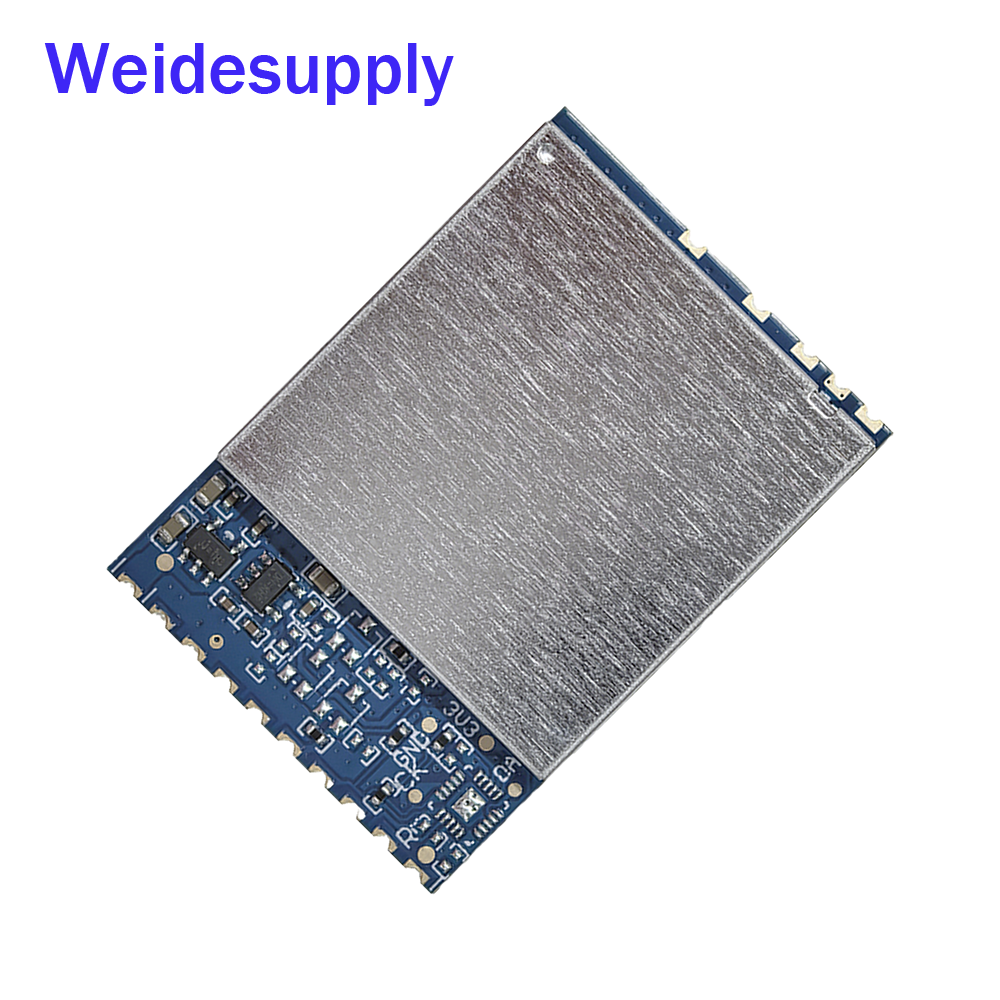
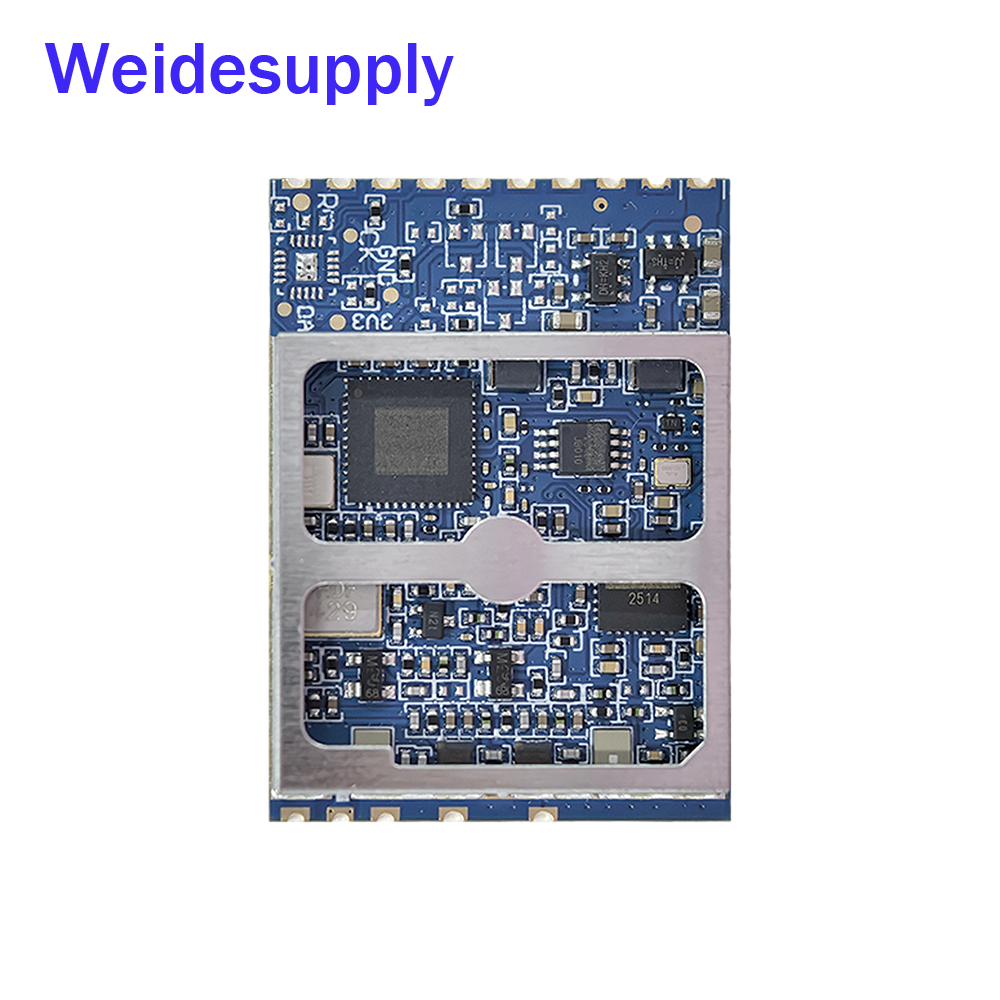
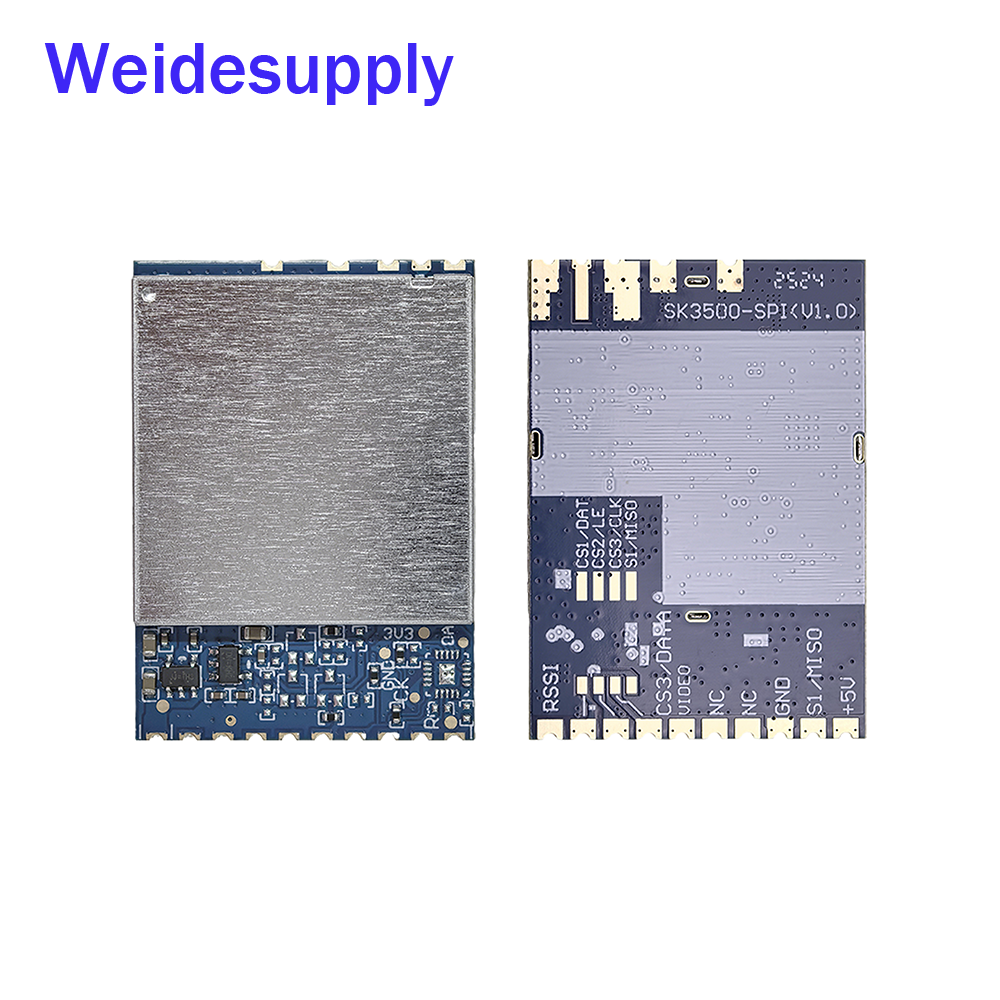
The SK3500-SPI delivers low-latency CVBS video reception across 3.1-3.8GHz with robust anti-interference capabilities. Designed for SPI-programmable customization, it supports advanced FPV applications including long-range drones, racing systems, and professional aerial platforms.
1. Technical Specifications
Electrical Characteristics
| Parameter | Specification |
| Supply Voltage | 5.0V DC ±5% |
| Current Consumption | 420mA ±30mA |
Environmental Ratings
| Parameter | Specification |
| Operating Temperature | -10°C to +65°C |
| Storage Temperature | -30°C to +85°C |
| Operating Humidity | ≤85% RH (non-condensing) |
RF Performance
| Parameter | Specification |
| Frequency Range | 3100 – 3800 MHz |
| Demodulation | FM/PLL |
| IF Frequency | 480 MHz |
| Antenna Impedance | 50 Ω |
| LO Stability | ±200 kHz |
| LO Precision | ±200 kHz |
| LO Control | Phase-Locked Loop (PLL) |
| LO Leakage | ≤ -65 dBm |
| Receiver Sensitivity | -95 dBm ±3 dBm |
| IF Bandwidth (3dB) | 16.5 MHz |
Video Performance
| Parameter | Specification |
| Output Impedance | 75 Ω |
| Output Level | 1V ±0.2Vp-p |
| Signal Polarity | Negative |
| Frequency Response | ±5dB (50Hz – 6MHz) |
| Differential Gain | ≤ ±5% |
| Differential Phase | ≤ ±5° |
| S/N Ratio | ≥38 dB |
| RSSI Slope | 22 mV/dBm |
Physical Specifications
| Parameter | Specification |
| Dimensions (L×W×H) | 37 × 26.3 × 4.5 mm |
| Weight | 5.2 g |
2. RSSI Output Reference
Measured with E4421B signal generator @ 5V supply
| Signal Strength | 3170 MHz | 3290 MHz | 3470 MHz |
| -136 dBm | 0.66V | 0.70V | 0.87V |
| -95 dBm | 0.81V | 0.88V | 1.09V |
| -90 dBm | 1.01V | 1.09V | 1.33V |
| -85 dBm | 1.28V | 1.37V | 1.62V |
| -80 dBm | 1.56V | 1.64V | 1.89V |
| -75 dBm | 1.84V | 1.92V | 2.17V |
| -70 dBm | 2.11V | 2.20V | 2.45V |
| -65 dBm | 2.40V | 2.50V | 2.67V |
| -60 dBm | 2.68V | 2.66V | 2.73V |
| -55 dBm | 2.81V | 2.76V | 2.78V |
| -50 dBm | 2.81V | 2.76V | 2.78V |
| -45 dBm | 2.83V | 2.78V | 2.80V |
| -40 dBm | 2.83V | 2.78V | 2.80V |
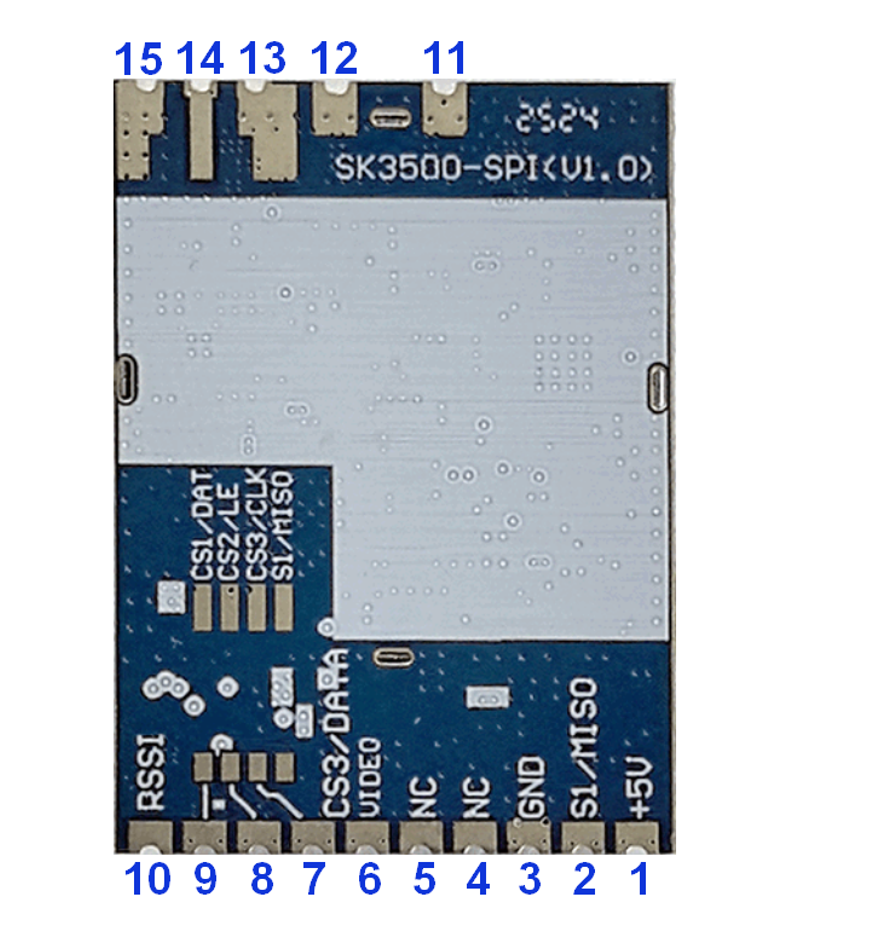
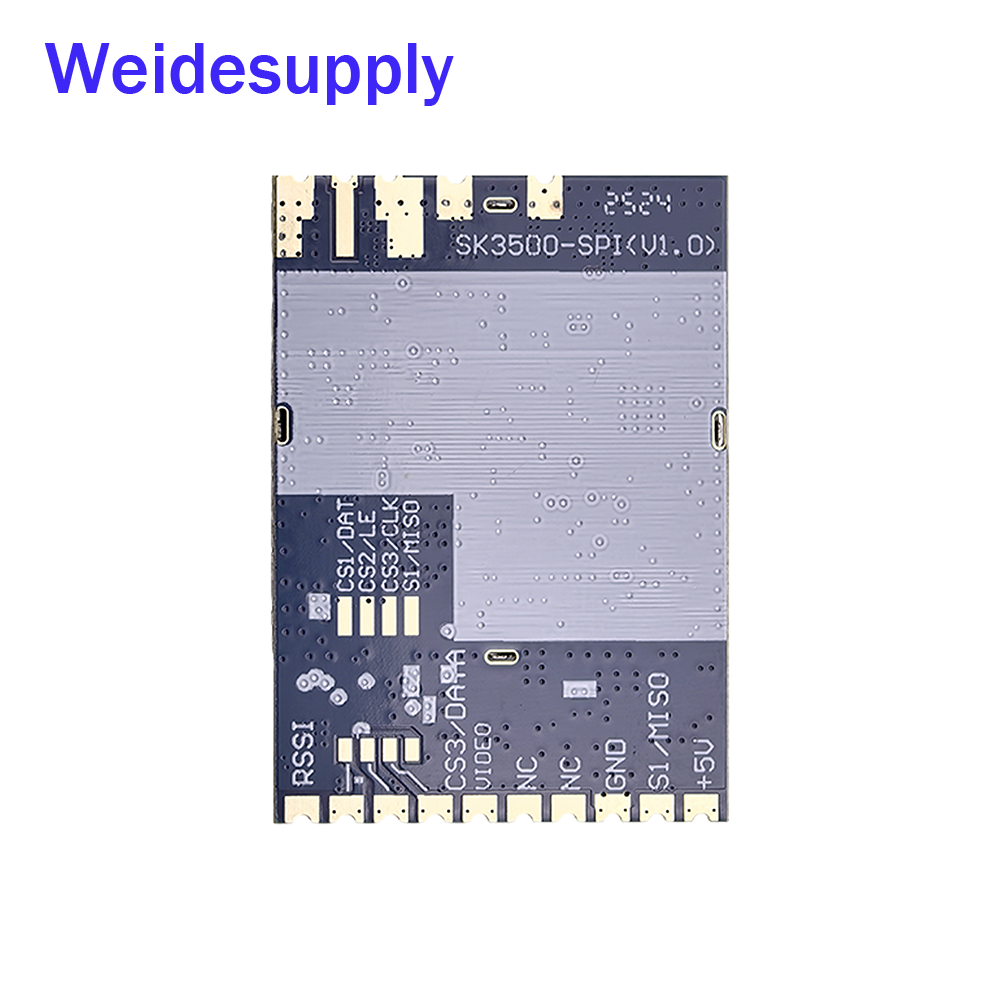
| Pin | Function |
|---|---|
| 1 | DCIN: +5V Power Input |
| 2 | S1: NC (No Connection) |
| 3 | GND |
| 4 | NC (No Connection) |
| 5 | NC (No Connection) |
| 6 | Video Output |
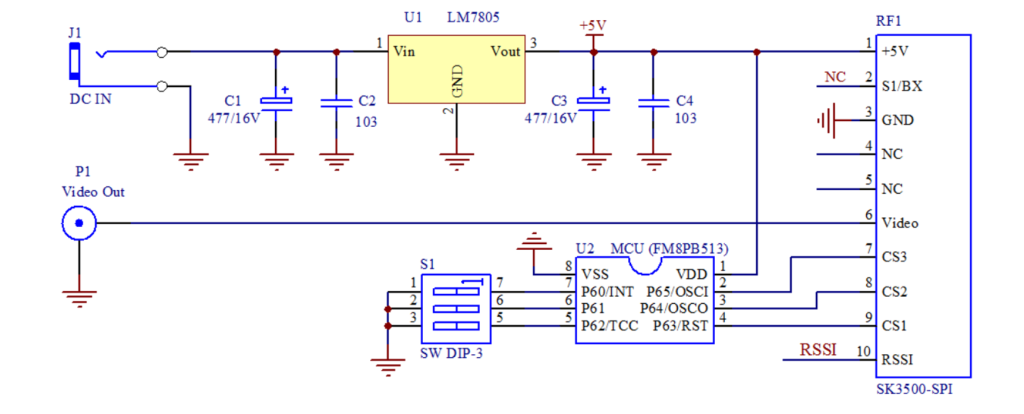
| 7 | SPI DATA (Frequency Control) |
| 8 | SPI LE (Frequency Control Latch) |
| 9 | SPI CLK (Frequency Control Clock) |
| 10 | RSSI (RF Signal Strength Ind.) |
| 11 | GND |
| 12 | GND |
| 13 | GND |
| 14 | RF Antenna Input (3.3GHz) |
| 15 | GND |
Key Features
Extended Frequency Range: 3100-3800MHz for interference-avoidance
SPI Programmability: Custom frequency tuning and channel hopping
High Sensitivity: -95dBm reception in congested RF environments
Linear RSSI Output: 22mV/dBm slope for precise signal monitoring
Ultra-Compact Design: 4.5mm profile for embedded applications
Typical Applications
Long-range FPV drone systems
Custom ground control stations
Industrial inspection drones
Racing drone diversity receivers
1. Introduction to FPV Receiver Innovation
The FPV (First Person View) drone industry thrives on real-time video transmission, where receiver performance dictates operational success. The SK3500-SPI emerges as a game-changer—a high sensitivity receiver operating at the 3.3GHz frequency band, designed to overcome signal interference, extend range, and deliver crystal-clear video feeds. Unlike traditional 5.8GHz systems prone to Wi-Fi congestion, this open-source module leverages advanced RF design and community-driven firmware to cater to racing, long-range exploration, and industrial applications. Its balance of performance and drone module price (typically $50-$100) makes it accessible to hobbyists and professionals alike.
2. Technical Specifications: Why 3.3G and Open Source Matter
- Frequency Band: 3.3GHz operation reduces interference from common 5.8GHz Wi-Fi networks and other drones, enhancing signal purity in urban or dense environments.
- High Sensitivity Receiver Capabilities: With a tracking sensitivity of -165 dBm, it captures weak signals effectively, minimizing video dropouts during low-altitude or obstacle-rich flights.
- SPI Interface: Enables low-latency communication with flight controllers (e.g., Arduino, Raspberry Pi), supporting real-time video processing for competitive racing.
- Open-Source Firmware: Allows customization for specific use cases—e.g., adding telemetry overlays or adapting to regional frequency regulations—via platforms like GitHub’s FPV Community.
- Power Efficiency: Operates at 3.3V with minimal heat generation, reducing the need for additional cooling systems.
3. Comparative Advantage: SK3500-SPI vs. Conventional Receivers
| Feature | SK3500-SPI | Standard 5.8GHz Receivers |
|---|---|---|
| Sensitivity | -165 dBm (high sensitivity) | -140 to -150 dBm |
| Interference Resistance | Low (3.3GHz band) | High (5.8GHz Wi-Fi congestion) |
| Customization | Full open-source firmware access | Limited closed-system options |
| Drone Module Price | $$ (Mid-range, $50-$100) | $ (Budget, $20-$50) |
| Table: Key differentiators highlighting performance and cost efficiency. |
The SK3500-SPI’s high sensitivity receiver design outperforms budget options like the RC832 (5.8GHz) in long-range scenarios, while its drone module price undercuts premium digital systems like DJI FPV HD (exceeding $200).
4. Applications: From Racing to Industrial Inspections
- FPV Racing: Low latency (<10ms) and robust signal capture enable precise maneuvering through complex courses.
- Long-Range Exploration: The 3.3GHz band penetrates obstacles better than higher frequencies, making it ideal for agricultural monitoring or search-and-rescue missions.
- Industrial Use: Integration with inspection drones for infrastructure assessments in high-interference environments (e.g., power plants).
- DIY Projects: Open-source compatibility supports custom integrations—e.g., pairing with Raspberry Pi for AI-driven signal optimization.
5. Integration Tips and Best Practices
- Antenna Pairing: Use high-gain antennas (e.g., 3.3G mushroom types) to maximize range. Ensure impedance matching (50Ω) for efficient power transfer.
- Power Management: Stabilize voltage input to prevent sensitivity fluctuations. A regulated 3.3V power source is critical.
- Shielding: Mount away from electromagnetic noise sources (ESCs, motors). Faraday cages can further reduce interference.
- Software Calibration: Utilize open-source tools like Betaflight to fine-tune frequency bands and output settings.
6. Market Context: Drone Module Price and Value Proposition
The SK3500-SPI’s drone module price positions it as a premium analog receiver with mid-range affordability. While budget 5.8GHz modules (e.g., Eachine RC832) cost $20-$30, they lack sensitivity and customization. Digital HD systems like DJI’s offer superior image quality but exceed $200. The SK3500-SPI bridges this gap, offering high sensitivity receiver performance at $50-$100—a value-driven choice for users seeking reliability without digital-tier costs.
7. Future-Proofing with Open-Source Evolution
Community-driven development continuously enhances the SK3500-SPI:
- AI Integration: Projects are underway to implement machine learning for dynamic frequency hopping, adapting to real-time interference.
- Hybrid Digital-Analog Support: Firmware updates may enable compatibility with emerging digital protocols.
- Global Compliance: Open-source maps for regional frequency regulations (e.g., FCC, CE) simplify international use.
8. Conclusion: Why SK3500-SPI Sets a New Standard
The SK3500-SPI redefines FPV reception by merging high sensitivity receiver capabilities, open-source flexibility, and a competitive drone module price. It addresses analog video’s limitations—interference, range, and customization—while remaining accessible to non-professionals. For pilots seeking to upgrade their video link without investing in digital systems, this module offers a technically advanced and economically smart solution.
Explore Further:
- FPV Receiver Design Principles (Open-Source GitHub Repository)
- Global Frequency Regulation Guidelines (International Telecommunication Union)
- Drone Antenna Integration Guide (Infinet Wireless Technical Wiki)